

ShareFarm
The brief
The farm-to-fork supply chain has long been opaque on both ends: farmers don't know who eventually buys their produce, consumers don't know where their food was grown, and the middle of the chain captures most of the margin. ShareFarm's founding bet was that a single connected platform — purpose-built portals for each actor in the chain — could rewire the economics so growers keep more of what they earn and consumers buy with full provenance.
Our remit was to design and build all three sides of that platform as one coherent system: the farmer app, the distributor logistics centre, and the consumer marketplace.
Three portals, one supply chain
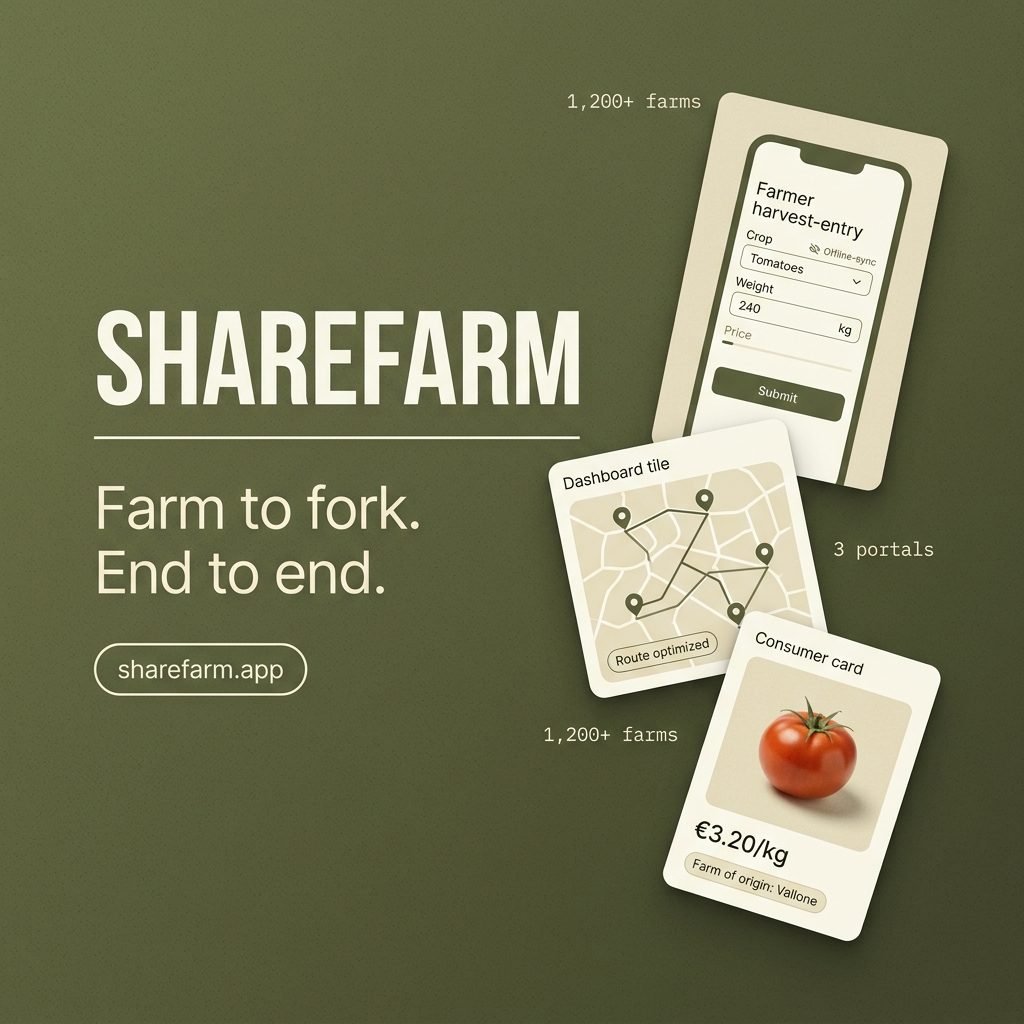
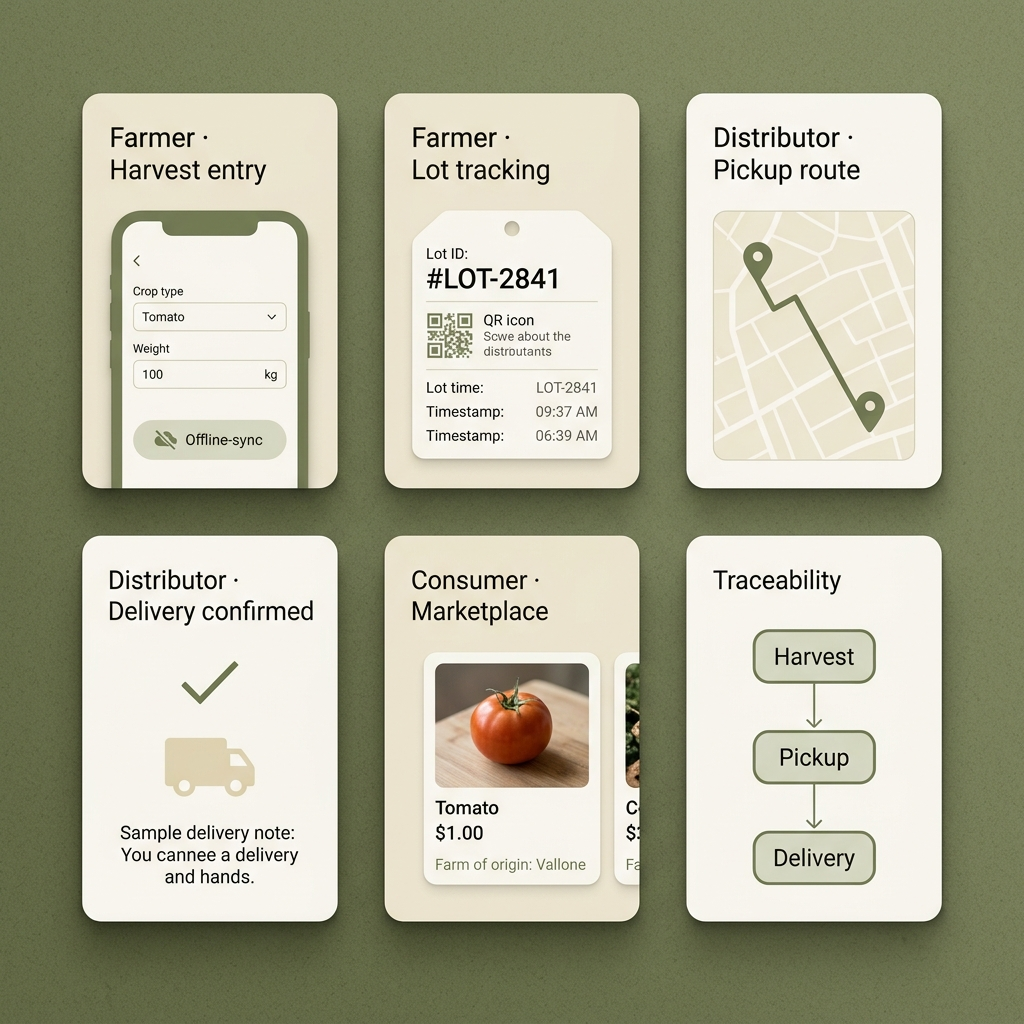
Each portal is its own product, tuned for the user in front of it, but they all read and write to the same canonical inventory and order graph. A pallet of tomatoes registered on a farm in the morning is bookable by a distributor by noon, visible to a consumer at the marketplace by evening, and traceable end-to-end at every step.
- Farmer app — offline-first mobile experience for harvest entry, lot tracking, pricing, and direct messages from distributors.
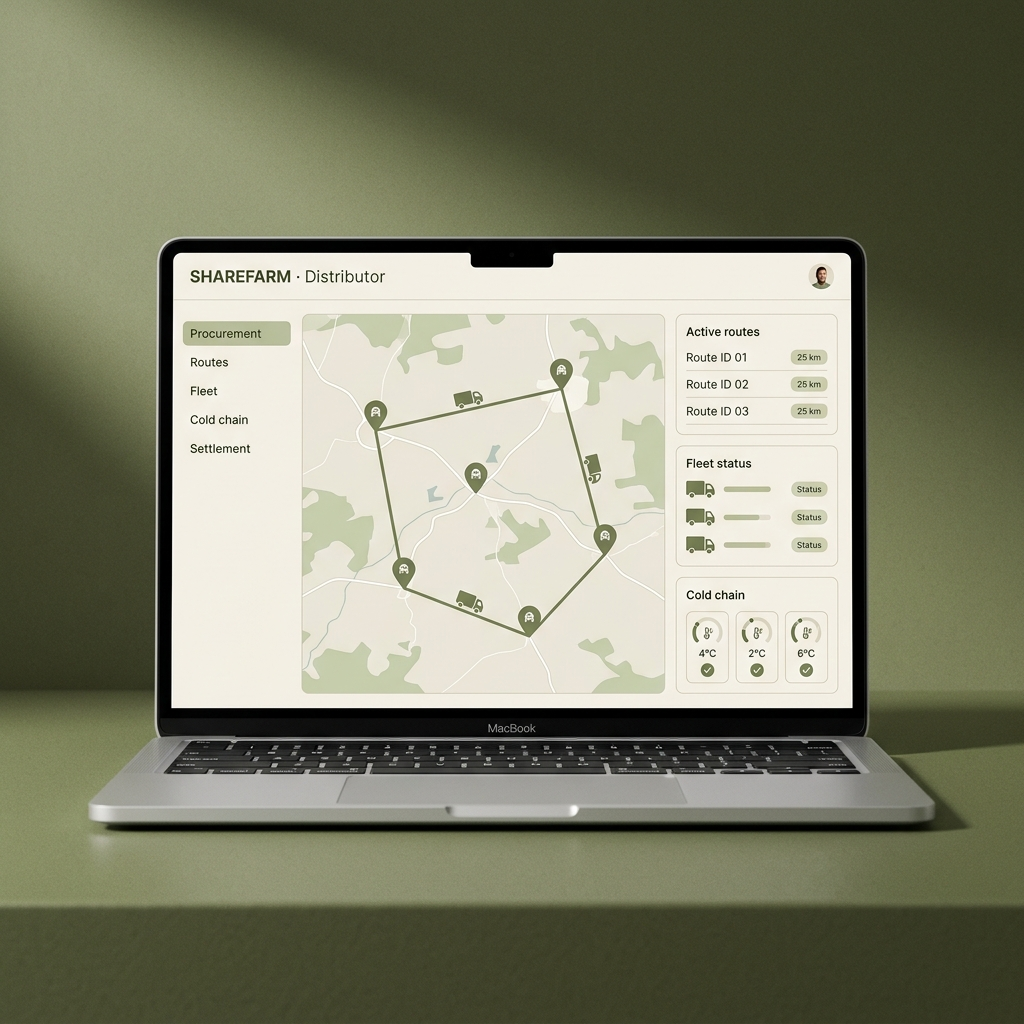
- Distributor centre — a web logistics console for procurement, route planning, fleet management, and cold-chain compliance.
- Consumer marketplace — a buyer-facing storefront with farm-of-origin on every product, subscription baskets, and pickup or delivery options.
The farmer app: offline-first by necessity
The farmer is the user with the worst connectivity, the busiest hands, and the least patience for an app that doesn't work in a polytunnel. We built the farmer-facing experience offline-first from the ground up: every action is captured locally and replayed to the server when connectivity returns, with conflict resolution and clear visual indicators of sync state. Lots, harvest weights, pricing, and chat all work whether or not there's bandwidth.
The distributor logistics centre: route optimization and cold chain
The distributor portal is the most algorithmically dense surface in the platform. It runs a vehicle-routing solver each time a new order or pickup is confirmed, balancing constraints the logistics team cares about: cold-chain temperature windows by product, vehicle capacity, driver hours, dock windows at retail destinations, and live road conditions. A separate demand-forecasting layer projects next-week pickup volume by farm and product, which feeds procurement planning and helps growers smooth their harvest cadence.
Traceability and provenance
Every product unit moves through the system with a tamper-evident chain of custody: harvest event → quality check → pickup → distribution centre → delivery. The consumer marketplace surfaces this lineage as a simple "farm of origin" panel on every product, with a deep link to the farm's profile, recent harvests, and growing practices. The same data feeds export certificates, retail-buyer audits, and food-safety recalls — a single source of truth for everyone downstream of the soil.
What we shipped
- An offline-first mobile app for farmers with harvest, lot, pricing, and conversation flows.
- A web logistics centre for distributors with constrained route optimization, fleet tracking, and cold-chain monitoring.
- A consumer marketplace with farm-of-origin provenance on every product, baskets, and subscriptions.
- A unified inventory and order graph backing all three portals.
- A traceability ledger powering provenance, audits, and recall workflows.
The result
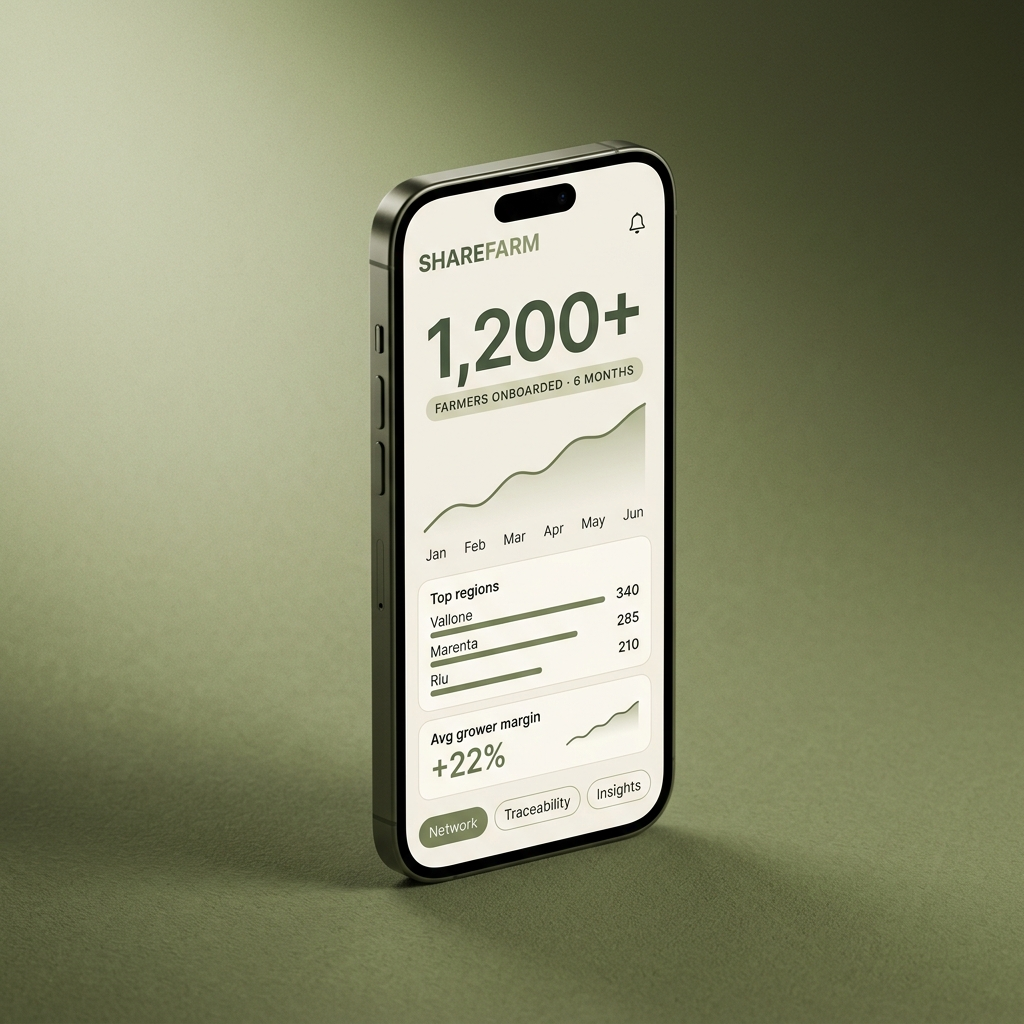
ShareFarm onboarded 1,200+ farmers in the first six months, with three-portal traffic that shows the model working: growers list and update inventory daily, distributors run routes from the console without spreadsheets, and consumers buy direct with full visibility into where every item came from. Margins demonstrably shift back up the chain, and the platform now operates as the canonical record for every transaction in its network.