


Players Table
The brief
Sports agencies run on relationships and paperwork in roughly equal measure. The agents we spoke to were juggling player profiles in a CRM, contracts in Dropbox, scouting notes in a private Slack, and value modelling on a notebook somebody updated when they had time. Each tool was usable; together they were a productivity tax, and crucially they were error-prone where errors hurt — missed contract expiries, untracked clauses, and value conversations that turned into "let me get back to you with that number."
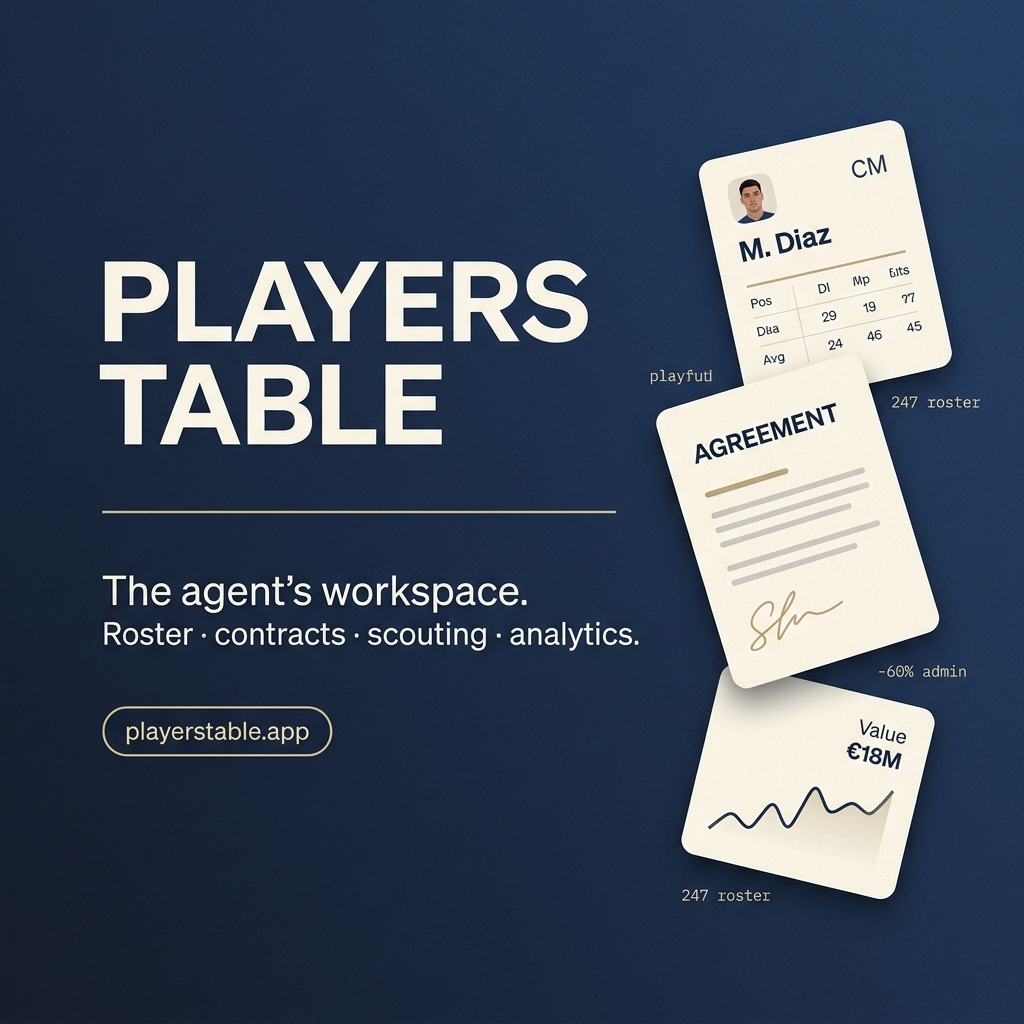
Players Table's brief was to collapse those four tools into a single workspace, designed around how a sports agent actually spends a working week.
A workspace built around the agent's week
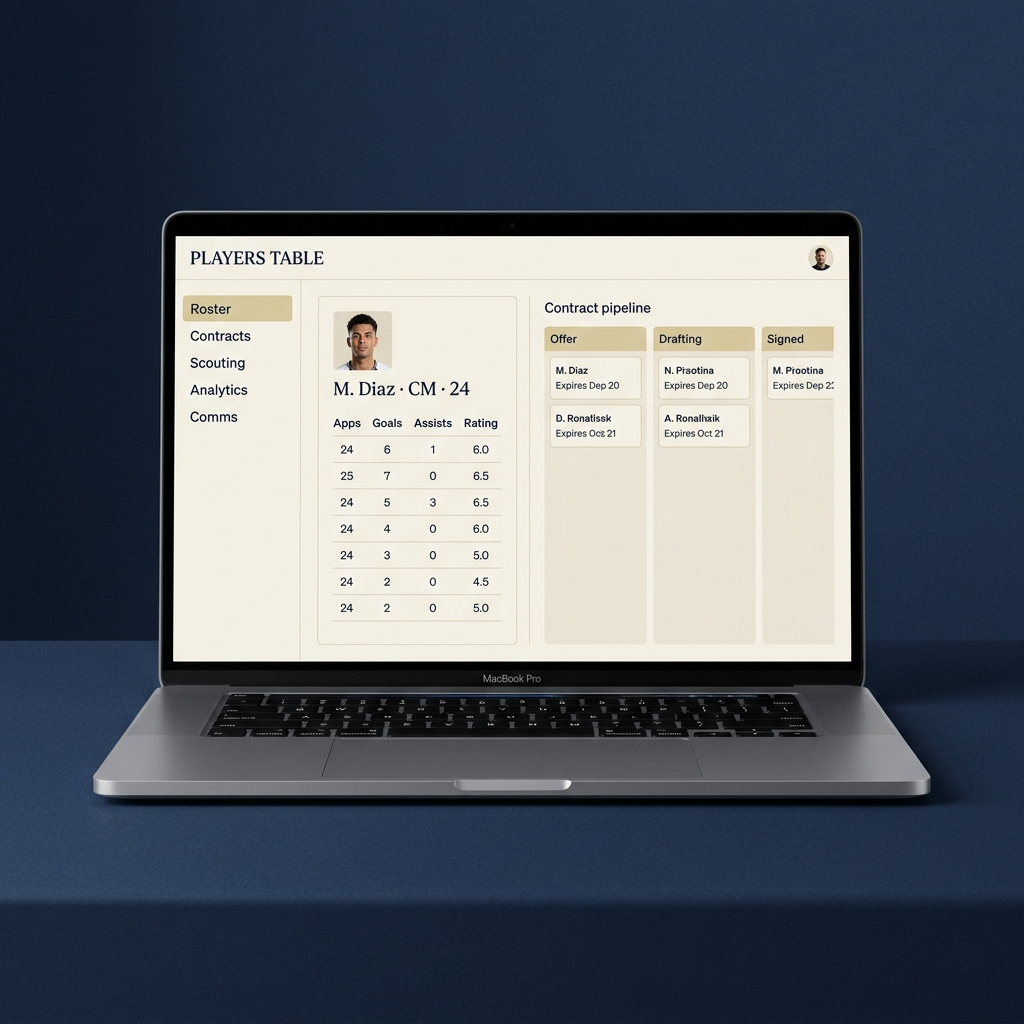
Rather than mirror legacy CRM patterns, we anchored the product on three timelines an agent already keeps in their head: the daily roster check-in, the weekly contract pipeline, and the monthly performance review. Every screen is reachable from any of those entry points, so the agent never feels they've left their main thread of work.
- Roster — every player as a living profile: club, position, age, injuries, recent form, calendar, and conversation history.
- Contracts — lifecycle from offer → draft → signed → renewal, with clause-level tracking and exposure alerts.
- Scouting — shortlist boards by position, age band, and contract status, fed by ingested club and league data.
- Analytics — roster valuation, contract risk by club and currency, and pipeline value rolled up to the principal.
- Comms — a unified inbox of player conversations, club enquiries, and reminders tied to records.
Contract intelligence
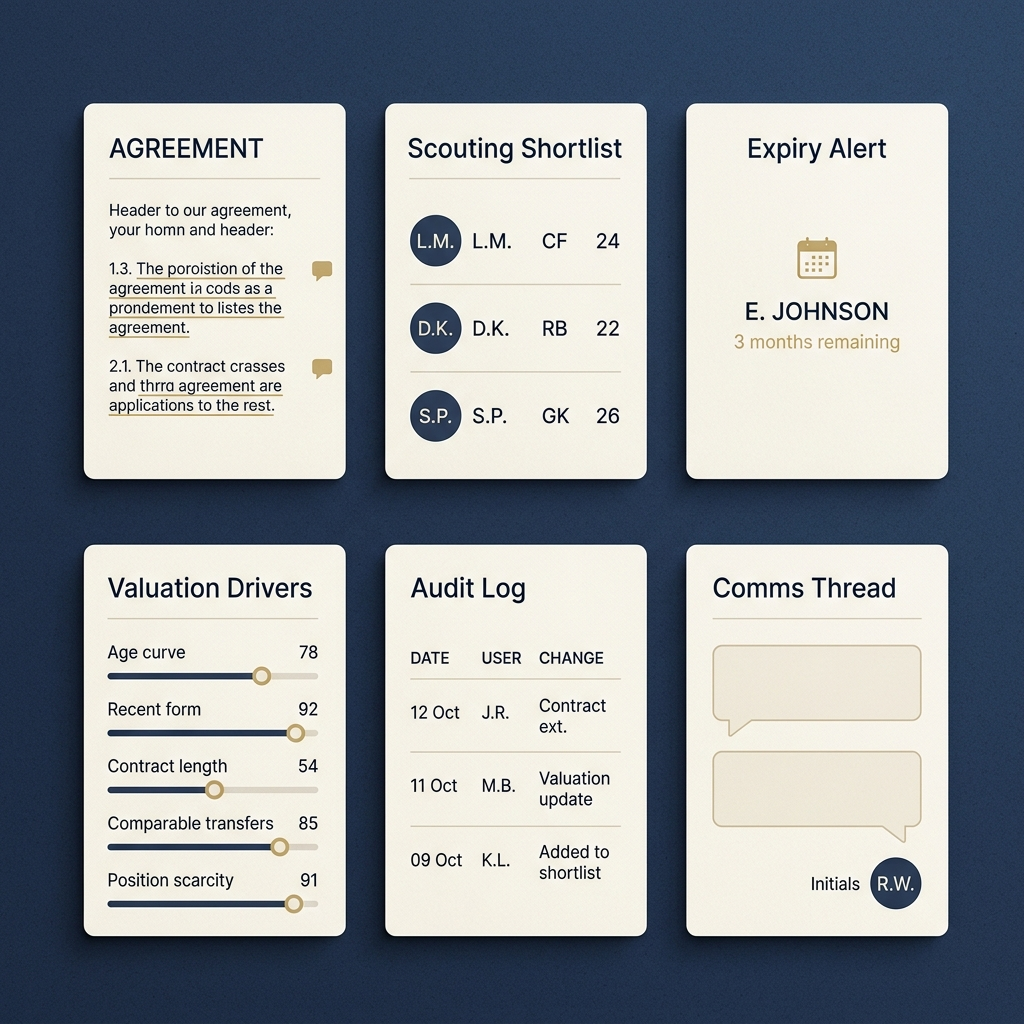
The contract layer is where the product earns its keep. We built a document-intelligence pipeline that parses uploaded contracts into a structured schema — parties, term, base wage, bonuses by trigger, release clauses, image-rights splits, agent commission — and surfaces each as a queryable field. The system flags ambiguous clauses for a human review pass, then powers downstream automation: expiry alerts at agent-configurable thresholds (12, 6, 3, 1 month), clause-trigger reminders, and pipeline forecasts based on contracted income across the roster.
Scouting and roster valuation
Scouting tools pull market data — clubs, recent transfers, valuation benchmarks — into shortlists agents can build, share with principals, and use during pitches. A roster-valuation model combines age curves, recent on-pitch performance, contract length, and comparable-transfer evidence to surface a defensible "fair value" range for each player. The number is a starting point for the conversation, not a verdict — agents can adjust drivers and see the value move, which is the right shape for the way they actually think.
Privacy, security, and audit
Player data is sensitive — wage details, medical notes, family information. The platform is built around per-record access controls, field-level redaction for shared views, and a tamper-evident audit log for every contract change. Single-sign-on, encryption at rest and in transit, and role-scoped API keys are baseline. Compliance was treated as a product feature, not an afterthought.
What we shipped
- The roster, contracts, scouting, analytics, and comms surfaces, unified into a single workspace.
- A document-intelligence pipeline that turns PDFs and scanned contracts into structured data.
- A roster-valuation model with explainable drivers the agent can tune in real time.
- Expiry, clause-trigger, and pipeline-risk alerting on top of the structured contract data.
- An enterprise-grade security layer — SSO, RBAC, audit logs, and field-level access controls.
The result
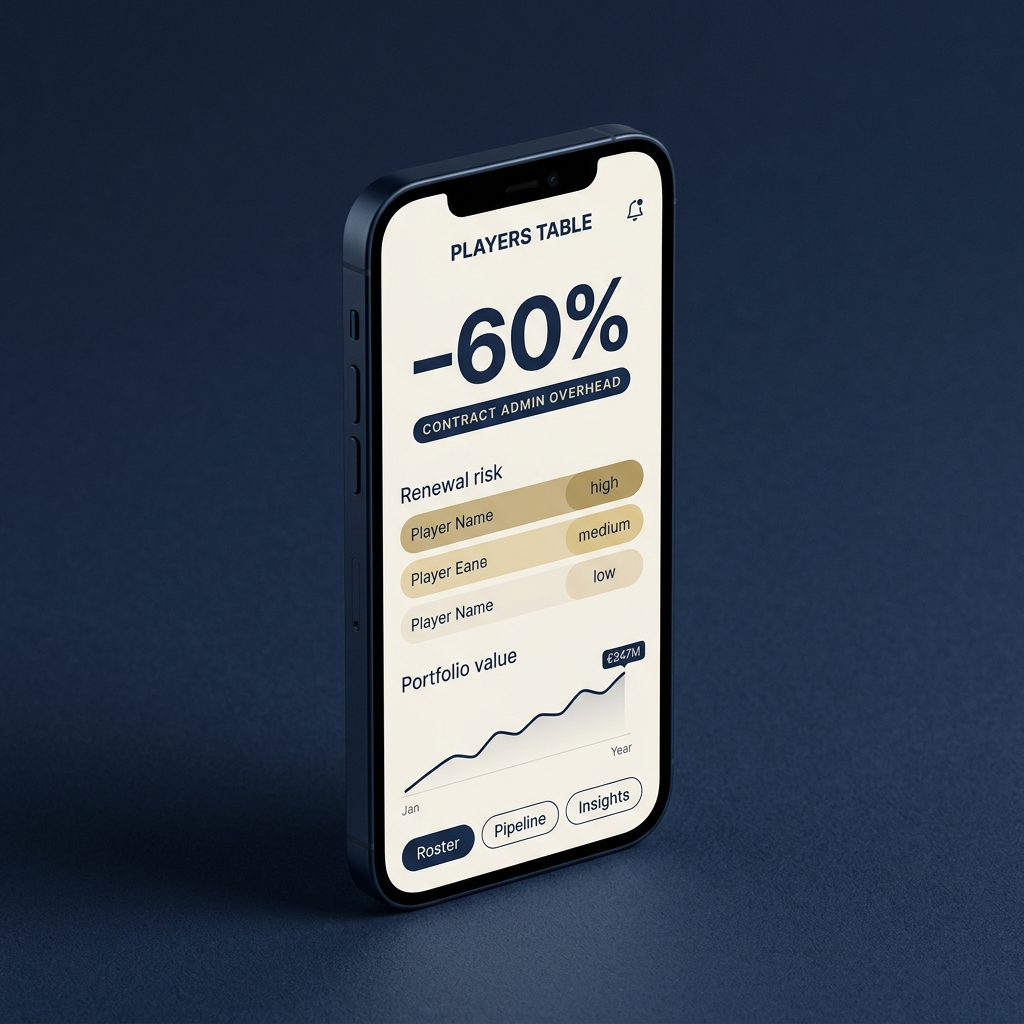
Players Table replaced the four-tool stack the average agency had been stitching together and gave principals a single source of truth for every person on their books. Agents report a 60% reduction in contract admin overhead — driven mostly by the disappearance of "what does this clause say again?" interruptions and the structured visibility into renewal exposure across the roster.